
Physics formulas help explain how objects move, how forces interact, how energy changes, and how electricity, light, heat, and waves behave. From calculating the speed of a moving vehicle to understanding the energy of a photon, mathematical equations make complex physical phenomena easier to describe and analyze.
This complete guide to physics formulas brings together important equations from mechanics, motion, work and energy, gravitation, thermodynamics, waves, electricity, magnetism, optics, and modern physics. Each section includes key formulas, explanations of variables, and practical examples to help students understand when and how to apply them.
Whether you are studying for school examinations, revising Class 9 to Class 12 physics, or preparing for competitive examinations such as JEE and NEET, this reference can help you organize your revision and strengthen your problem-solving skills.
Download Physics Formulas PDF (Free)
Want to revise physics formulas and equations offline? Use the free Physics Formulas PDF to review important formulas, revise key concepts, and prepare for tests and examinations.
Download Free Physics Formulas PDFPro Tip: Print the physics formulas cheat sheet and keep it near your study desk. Reviewing these formulas daily will help you remember them and strengthen your long-term memory.
List of all Physics Formulas (Basic to Advanced)
Explore the complete list of physics formulas, from basic to advanced, with clear explanations and step-by-step examples to help you solve problems and prepare for exams.
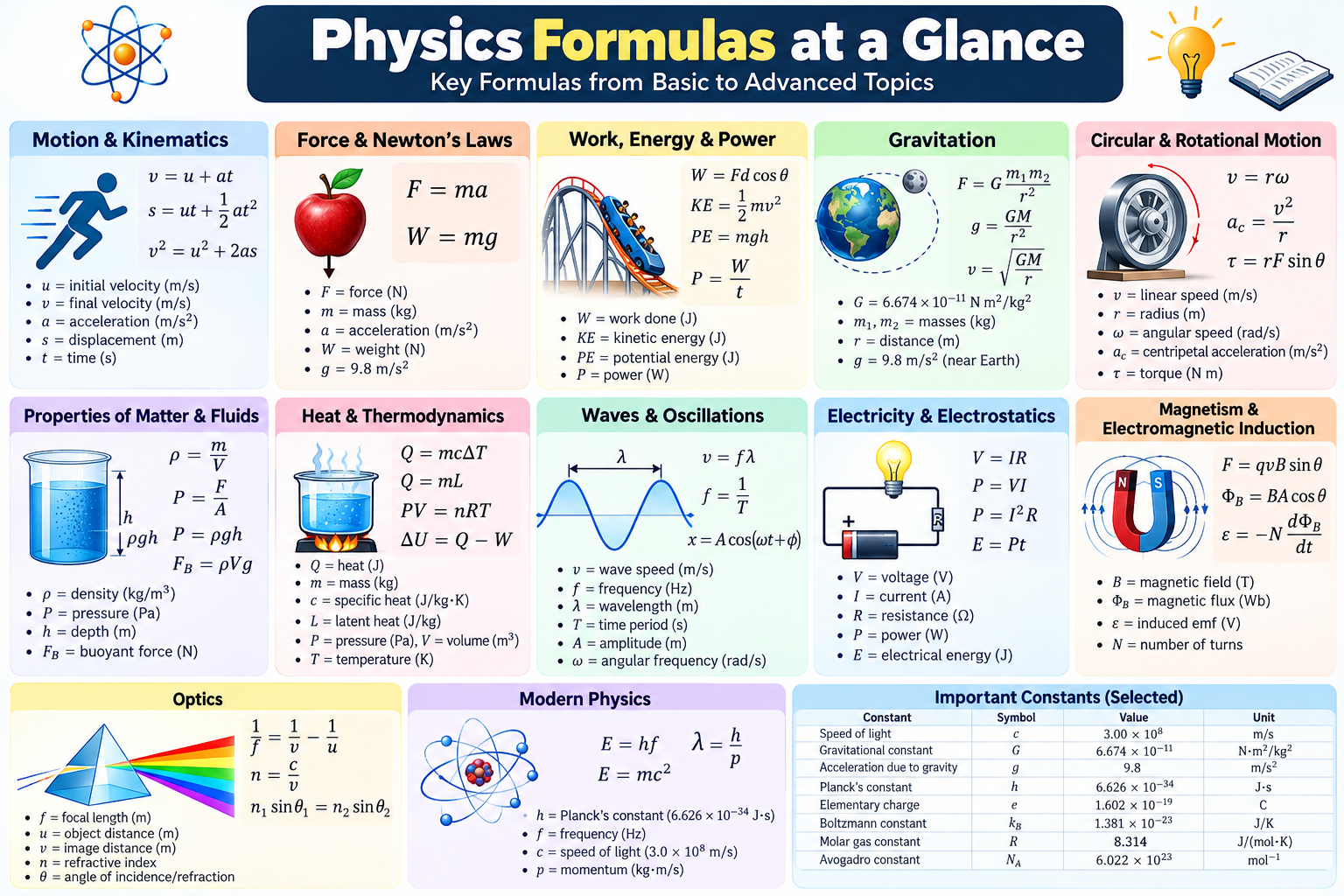
Basic Physics Formulas
Basic physics equations describe fundamental quantities such as distance, speed, velocity, acceleration, mass, density, force, and pressure. These relationships are used throughout physics and provide the foundation for more advanced calculations.
| Physical quantity | Formula | SI unit |
| Speed | v = d / t | m/s |
| Average speed | Total distance / Total time | m/s |
| Average velocity | Displacement / Time interval | m/s |
| Acceleration | a = (v – u) / t | m/s² |
| Density | ρ = m / V | kg/m³ |
| Force | F = ma | N |
| Momentum | p = mv | kg·m/s |
| Pressure | P = F / A | Pa |
| Weight | W = mg | N |
| Frequency | f = 1 / T | Hz |
Symbols used: (d) represents distance, (t) represents time, (u) is initial velocity, (v) is final velocity or speed depending on the equation, (a) is acceleration, (m) is mass, (V) is volume, (A) is area, and (g) is gravitational acceleration.
Example: A cyclist travels 120 metres in 10 seconds. The average speed is:
v = 120 / 10 = 12 m/sTherefore, the cyclist’s average speed is 12 m/s
Remember that speed is a scalar quantity, whereas velocity includes direction. Average speed uses total distance, while average velocity uses net displacement.
Motion and Kinematics Formulas
Kinematics studies the motion of objects without examining the forces responsible for that motion. Its equations are particularly useful for problems involving acceleration, braking, falling objects, and moving vehicles.
Equations of uniformly accelerated motion
For motion in a straight line with constant acceleration, the following equations are commonly used:
| Equation | Formula |
| First equation of motion | v = u + at |
| Second equation of motion | s = ut + ½at² |
| Third equation of motion | v² = u² + 2as |
| Average velocity under constant acceleration | Average velocity = (u + v) / 2 |
| Displacement using average velocity | s = [(u + v) / 2] × t |
Here, (u) is initial velocity, (v) is final velocity, (a) is constant acceleration, (t) is elapsed time, and (s) is displacement.
These equations assume constant acceleration along a straight line. They should not be applied automatically to situations where acceleration changes significantly with time.
Example: Finding final velocity
A vehicle starts at 5 m/s and accelerates at 3 m/s² for 4 seconds. Find its final velocity.
Using the first equation:
v = u + at

v = 5 + (3 × 4) = 17 m/s
The final velocity is 17 m/s.
Free-fall formulas
When air resistance is negligible, a falling object near Earth’s surface experiences approximately constant gravitational acceleration.
Important equations include:
v = u + gt

h = ut + ½gt²

v² = u² + 2gh
These forms assume downward is the positive direction. If upward is defined as positive, the signs of gravitational acceleration and displacement must be adjusted accordingly.
For an object released from rest from a height (h):
t = √(2h / g)This formula is useful for estimating the time taken to fall a given distance, provided air resistance is ignored.
Projectile motion formulas
Projectile motion describes an object moving through the air under gravity, assuming air resistance is negligible.
For an initial speed (u) at an angle (θ) above the horizontal:
Horizontal velocity

uₓ = u cos θ

Vertical velocity

uᵧ = u sin θ

Horizontal displacement

x = (u cos θ) × t

Vertical displacement

y = (u sin θ) × t - ½gt²

For a projectile launched and landing at the same height:

Time of flight

T = (2u sin θ) / g

Maximum height

H = (u² sin² θ) / (2g)

Horizontal range

R = (u² sin 2θ) / g
The range formula assumes the launch and landing elevations are equal and the gravitational field is approximately uniform. It is not directly applicable when the projectile lands at a different height.
Newton’s Laws and Force Formulas
Force is an interaction that can change an object’s motion. Newton’s laws describe the relationship between force, mass, acceleration, and momentum.
Newton’s second law
F = maWhere:
- (F) = net force in newtons
- (m) = mass in kilograms
- (a) = acceleration in m/s²
The equation uses the net force, meaning the vector sum of all forces acting on the object.
Weight formula
W = mgMass measures the amount of matter in an object, while weight is the gravitational force acting on it. Mass is measured in kilograms and weight in newtons.
Friction formula
For dry friction in the standard introductory model:
Kinetic friction

fₖ = μₖN

Maximum static friction

fₛ,ₘₐₓ = μₛN
Here, (μₖ) and (μₛ) are the coefficients of kinetic and static friction, and (N) is the normal force.
Static friction is not always equal to (μₛN). It adjusts to oppose the applied tangential force until it reaches its maximum value.
Momentum and impulse
Linear momentum

p = mv

Impulse

J = Fₐᵥg × Δt = Δp
Impulse equals the change in momentum. The second expression assumes the average net force is taken over the specified time interval.
Spring force: Hooke’s law
F = -kxHere, (k) is the spring constant and (x) is the displacement from the equilibrium position. The negative sign indicates that the restoring force acts opposite to the displacement for an ideal spring within its elastic range.
Work, Energy, and Power Formulas
Work, energy, and power are closely related concepts used to analyze moving objects, machines, electrical devices, and energy transfers.
Work done by a force
For a constant force acting through a displacement:
W = Fd cos θHere, (F) is force, (d) is displacement, and (θ) is the angle between the force and displacement.
When force and displacement are parallel, work is (Fd). When they are perpendicular, the work done by that force is zero.
Kinetic energy
Kinetic energy is the energy associated with motion.
KE = ½mv²An increase in speed can produce a substantial increase in kinetic energy because velocity is squared.
Gravitational potential energy
For an object near Earth’s surface, where (g) is approximately constant:
PE = mghHere, (h) is the height measured from a chosen reference level.
Elastic potential energy
For an ideal spring:
PE of spring = ½kx²This formula applies to an ideal spring obeying Hooke’s law.
Mechanical energy
Mechanical energy = KE + PEMechanical energy remains constant in an ideal system when only conservative forces do work and no energy is transferred into or out of the system.
Power
Average power is the rate of doing work:
P = W / tIt can also be expressed as the rate of energy transfer:
P = ΔE / ΔtFor instantaneous power when a force acts on a moving object:
P = F · vThe SI unit of power is the watt (W).
Efficiency
Efficiency = (Useful output energy / Input energy) × 100%Efficiency can also be calculated using useful output power divided by input power, multiplied by 100%.
Gravitation Formulas
Gravitation is the attractive interaction between objects with mass. These formulas help explain falling objects, planetary motion, satellites, and gravitational fields.
Newton’s law of universal gravitation
F = G × (m₁m₂ / r²)Where:
- (F) = gravitational force
- (G) = universal gravitational constant
- (m₁, m₂) = masses of the objects
- (r) = distance between their centres
The force becomes weaker as the distance between the centres increases.
Gravitational acceleration
For an approximately spherical body:
g = GM / r²Here, (M) is the mass of the body and (r) is the distance from its centre. Near Earth’s surface, this value is approximately 9.8 m/s².
Gravitational potential energy
For two point masses, taking zero potential energy at infinite separation:
U = -GMm / rThe negative sign reflects the convention that gravitational potential energy is zero at infinite separation and becomes more negative as the objects move closer.
Orbital speed
For a circular orbit around a much more massive body:
v = √(GM / r)This equation assumes gravity provides the centripetal force and that the orbit is circular.
Escape velocity
For an object escaping an isolated spherical body’s gravitational field without additional propulsion or atmospheric losses:
vₑ = √(2GM / r)Escape velocity depends on the body’s mass and the distance from its centre, rather than the mass of the escaping object.
Circular Motion and Rotational Motion Formulas
Circular motion describes movement along a circular path. Rotational motion focuses on how an object turns around an axis.
Angular velocity
ω = Change in angle / Change in time

ω = Δθ / Δt

For uniform circular motion:

v = rω
Here, (v) is tangential speed, (r) is radius, and (ω) is angular speed in radians per second.
Centripetal acceleration
a꜀ = v² / r = rω²This acceleration points toward the center of the circular path.
Centripetal force
F꜀ = mv² / r = mrω²Centripetal force is not a separate type of force. It is the net inward force needed to maintain circular motion.
Torque
τ = rF sin θHere, (r) is the distance from the axis to the point of application, (F) is the force, and (θ) is the angle between the position vector and force.
Rotational form of Newton’s second law
For rotation about a fixed axis with constant moment of inertia:
Net torque = Iα

τₙₑₜ = Iα
Here, (I) is the moment of inertia and (α) is angular acceleration.
Rotational kinetic energy
KE of rotation = ½Iω²Simple pendulum
For small oscillations of an ideal simple pendulum:
T = 2π√(L / g)The period (T) is the time for one complete oscillation, and (L) is the pendulum length. This approximation is most accurate for small angular displacements.
Properties of Matter and Fluid Mechanics Formulas
These equations describe density, pressure, elasticity, buoyancy, and fluid flow.
| Quantity | Formula |
| Density | ρ = m / V |
| Pressure | P = F / A |
| Pressure at depth in a static fluid | P = P₀ + ρgh |
| Buoyant force | Fᴮ = ρ of fluid × g × displaced volume |
| Young’s modulus | Longitudinal stress / Longitudinal strain |
| Surface tension | γ = F / L for a single liquid surface and force distributed along a line |
The surface tension expression depends on how the force is defined. For a soap film with two surfaces, the total force along a movable wire is commonly:
F = 2γLContinuity equation
For steady flow of an incompressible fluid through a pipe:
A₁v₁ = A₂v₂
Where (A) is the cross-sectional area and (v) is the fluid speed.
This equation shows that the flow speed increases when the pipe narrows, provided the volume flow rate remains constant.
Bernoulli’s equation
For steady, incompressible, non-viscous flow along a streamline:
P + ½ρv² + ρgh = constant
The terms represent pressure energy per unit volume, kinetic energy per unit volume, and gravitational potential energy per unit volume.
Heat and Thermodynamics Formulas
Thermodynamics studies heat, temperature, work, internal energy, and the behavior of systems that exchange energy.
Heat gained or lost
When a substance experiences a temperature change without a phase change:
Q = mcΔT
Here, (Q) is heat transferred, (m) is mass, (c) is specific heat capacity, and (ΔT) is the temperature change.
Latent heat
During a phase change at the appropriate transition temperature:
Q = mL
Here, (L) is the specific latent heat. Temperature remains approximately constant during an ideal phase change at constant pressure.
Heat capacity
C = Q / ΔT
Heat capacity refers to the heat needed to raise the temperature of an entire object or system by one kelvin.
First law of thermodynamics
Using the convention that (W) is work done by the system:
Change in internal energy = Heat added – Work done
ΔU = Q – W
Here, (ΔU) is the change in internal energy and (Q) is heat added to the system.
Ideal gas equation
PV = nRT
Where:
- (P) = absolute pressure
- (V) = volume
- (n) = amount of substance in moles
- (R) = molar gas constant
- (T) = absolute temperature in kelvin
The ideal gas equation is a useful model for many gases under conditions where deviations from ideal behavior are small.
Thermal expansion
For small temperature changes and a uniform material:
Linear expansion
Change in length = Expansion coefficient × Original length × Temperature change
ΔL = αL₀ΔT
Volume expansion
Change in volume = Volume expansion coefficient × Original volume × Temperature change
ΔV = βV₀ΔT
Here, (α) is the linear expansion coefficient and (β) is the volume expansion coefficient.
Oscillations and Wave Formulas
Oscillations are repeated motions around an equilibrium position. Waves transfer energy from one location to another through a medium or through space, depending on the wave type.
Frequency and time period
Frequency = 1 / Time period
f = 1 / T
Here, (f) is frequency in hertz and (T) is the time period in seconds.
Wave speed
Wave speed = Frequency × Wavelength
v = fλ
Where (v) is wave speed, (f) is frequency, and (λ) is wavelength.
Angular frequency
ω = 2πf = 2π / T
Angular frequency is measured in radians per second.
Simple harmonic motion
A standard displacement equation is:
x = A cos(ωt + φ)
Here, (A) is amplitude and (φ) is the initial phase constant.
The acceleration in simple harmonic motion is:
a = -ω²x
The negative sign indicates that acceleration points toward the equilibrium position.
Spring-mass system
For an ideal mass attached to a spring oscillating horizontally without damping:
T = 2π√(m / k)
Sound intensity
For sound spreading uniformly in all directions from a point source in a free field:
Intensity = Power / Area
I = P / A
For a spherical wave spreading over an area (A = 4πr²):
I = P / (4πr²)
Here, (P) is the sound power passing through the area. Real environments may differ because of reflections, absorption, and other effects.
Electricity and Electrostatics Formulas
Electricity formulas describe electric charge, current, voltage, resistance, electrical energy, and interactions between charges.
Electric current
Current = Charge / Time
I = Q / t
For a constant current, (Q) is the charge transferred in time (t). More generally, instantaneous current is:
I = dQ / dt
Ohm’s law
Voltage = Current × Resistance
V = IR
This relationship applies to an ohmic conductor under conditions where its resistance remains constant.
Electrical power
Power = Voltage × Current
P = VI
Using Ohm’s law, power can also be written as:
P = I²R
P = V² / R
Electrical energy
For constant power:
E = Pt
For a resistor with constant resistance:
E = I²Rt
Resistance of a wire
For a uniform conductor:
R = ρL / A
Here, (ρ) is the material’s electrical resistivity, (L) is the wire length, and (A) is its cross-sectional area.
Resistors in series
Equivalent resistance = R₁ + R₂ + … + Rₙ
Rₑq = R₁ + R₂ + … + Rₙ
Resistors in parallel
1 / Rₑq = 1 / R₁ + 1 / R₂ + … + 1 / Rₙ
For two resistors in parallel, this simplifies to:
Rₑq = (R₁ × R₂) / (R₁ + R₂)
Coulomb’s law
For two point charges in a vacuum:
F = kₑ × |q₁q₂| / r²
Here, (kₑ) is Coulomb’s constant, (q₁) and (q₂) are the charges, and (r) is the separation between them. Like charges repel and unlike charges attract.
Electric field
For a test charge (q) experiencing an electric force (F):
E = F / q
For a point charge in a vacuum, the field magnitude is:
E = kₑ × |Q| / r²
Electric potential and capacitance
For a point charge in a vacuum, taking potential to be zero at infinity:
V = kₑQ / r
Capacitance is defined as:
C = Q / V
For a parallel-plate capacitor in vacuum or air, neglecting edge effects:
C = ε₀A / d
The energy stored in an ideal capacitor can be calculated using:
U = ½CV²
Magnetism and Electromagnetic Induction Formulas
Magnetism and electromagnetic induction explain the behavior of magnetic fields, forces on moving charges, and the generation of induced voltages.
Magnetic force on a moving charge
F = |q|vB sin θ
Here, (θ) is the angle between the particle’s velocity and the magnetic field.
Magnetic force on a current-carrying wire
For a straight wire segment in a uniform magnetic field:
F = BIL sin θ
Here, (B) is magnetic flux density, (I) is current, and (L) is the wire length within the field.
Magnetic flux
For a uniform magnetic field through a flat surface:
Φᴮ = BA cos θ
Here, (θ) is the angle between the magnetic field and the surface’s normal vector.
Faraday’s law of electromagnetic induction
Induced voltage = – Number of coil turns × Change in magnetic flux / Time taken
ℰ = -N × (ΔΦᴮ / Δt)
Here, (N) is the number of coil turns and (ℰ) is the induced electromotive force. The negative sign represents Lenz’s law: the induced effect opposes the change in magnetic flux that produces it.
Transformer equation
For an ideal transformer operating with alternating current:
Secondary voltage / Primary voltage = Secondary turns / Primary turns
Vₛ / Vₚ = Nₛ / Nₚ
Here, (Vₚ, Vₛ) are primary and secondary voltages, and (Nₚ, Nₛ) are their respective numbers of turns.
This relationship assumes an ideal transformer with negligible losses.
Optics and Lens Formulas
Optics studies light, image formation, reflection, refraction, and optical instruments.
Law of reflection
Angle of incidence = Angle of reflection
θᵢ = θᵣ
The angle of incidence equals the angle of reflection, with both angles measured from the normal to the reflecting surface.
Refractive index
For light travelling through a medium:
Refractive index = Speed of light in vacuum / Speed of light in the medium
n = c / v
Here, (c) is the speed of light in vacuum and (v) is the phase speed of light in the medium.
Snell’s law
n₁ sin θ₁ = n₂ sin θ₂
The angles are measured from the normal at the boundary between the two media.
Thin-lens equation
Using the common Cartesian sign convention for a thin lens:
1 / f = 1 / v – 1 / u
Here, (f) is focal length, (u) is object distance, and (v) is image distance. Be consistent with the chosen sign convention when solving problems.
Magnification of a thin lens
Magnification = Image height / Object height = Image distance / Object distance
m = hᵢ / hₒ = v / u
Under the Cartesian sign convention, the signed distances and image heights determine whether the image is upright or inverted.
Power of a lens
Lens power = 1 / Focal length
P = 1 / f
For this formula, focal length must be measured in metres and lens power is expressed in dioptres (D).
For example, a converging lens with a focal length of 0.5 m has a power of:
P = 1 / 0.5 = +2 D
The plus sign indicates a converging lens under the usual sign convention.
Modern Physics Formulas
Modern physics examines phenomena that classical physics cannot fully describe, including quantum behavior, atomic structure, and special relativity.
Photon energy
Photon energy = Planck’s constant × Frequency
E = hf
Using the relationship between frequency and wavelength:
E = hc / λ
Here, (h) is Planck’s constant, (f) is frequency, (c) is the speed of light in vacuum, and (λ) is wavelength.
Einstein’s mass-energy equivalence
Energy = Mass × (Speed of light)²
E = mc²
This equation expresses the rest energy associated with mass.
de Broglie wavelength
For a particle with momentum (p):
λ = h / p
For a non-relativistic particle of mass (m) and speed (v), where (p = mv):
λ = h / (mv)
Radioactive decay
Number of nuclei remaining = Initial number of nuclei × e^(-decay constant × time)
N = N₀e^(-λt)
Here, (N₀) is the initial number of undecayed nuclei, (N) is the number remaining after time (t), and (λ) is the decay constant.
Half-life
Half-life = ln(2) / Decay constant
T₁/₂ = ln(2) / λ
The half-life is the time required for half of the radioactive nuclei in a sample to decay.
Important Physics Constants
Physical constants are values used in equations describing nature. The following approximate values are commonly encountered in school and introductory university physics.
| Constant | Symbol | Approximate value |
| Speed of light in vacuum | c | 3.00 × 10⁸ m/s |
| Gravitational constant | G | 6.674 × 10⁻¹¹ N·m²/kg² |
| Standard gravitational acceleration near Earth | g | 9.81 m/s² |
| Planck constant | h | 6.626 × 10⁻³⁴ J·s |
| Elementary charge magnitude | e | 1.602 × 10⁻¹⁹ C |
| Boltzmann constant | kᴮ | 1.381 × 10⁻²³ J/K |
| Molar gas constant | R | 8.314 J/(mol·K) |
| Avogadro constant | Nᴬ | 6.022 × 10²³ mol⁻¹ |
| Vacuum permittivity | ε₀ | 8.854 × 10⁻¹² F/m |
| Coulomb constant | kₑ | 8.988 × 10⁹ N·m²/C² |
Values are rounded for convenient calculations. Use the precision and constants specified in your textbook, examination, or problem statement when required.
Try Free AI solvers:
How to Use Physics Formulas Correctly
Knowing a formula is only part of solving a physics problem. You also need to identify the physical situation, choose the correct relationship, use consistent units, and check whether the answer makes sense.
Step 1: Identify the given quantities
Write down the values supplied in the question, including their units. Identify what needs to be calculated.
Step 2: Choose the relevant equation
Match the known and unknown quantities to a formula that applies under the conditions described in the problem.
Step 3: Convert units to SI
Common conversions include:
- Kilometres to metres: multiply by 1,000.
- Minutes to seconds: multiply by 60.
- Grams to kilograms: divide by 1,000.
- Kilometres per hour to metres per second: multiply by 5 / 18.
- Celsius to kelvin: add 273.15.
Step 4: Substitute the values
Insert the known quantities into the equation, keeping track of units and signs.
Step 5: Calculate and check the result
Complete the arithmetic and confirm that the result has the correct unit and a reasonable magnitude.
Example: Calculating force
A 4 kg object accelerates at 2.5 m/s². Find the net force.
Given:

m = 4 kg, a = 2.5 m/s²

Using Newton's second law:

F = ma

F = 4 × 2.5 = 10 N

Answer: The net force is 10 N.
Common Mistakes When Learning Physics Formulas
Students often lose marks not because they cannot remember a formula, but because they apply it incorrectly.
- Mixing up distance and displacement: Use distance for average speed and displacement for average velocity.
- Ignoring units: A speed given in km/h cannot be substituted directly into an equation expecting m/s without conversion.
- Using the wrong acceleration assumption: The standard kinematics equations require constant acceleration.
- Forgetting signs and directions: Velocity, acceleration, displacement, and force may be positive or negative depending on the chosen coordinate system.
- Confusing mass and weight: Mass is measured in kilograms; weight is a force measured in newtons.
- Memorizing without understanding: Learn what each variable means and what assumptions make an equation valid.
- Rounding too early: Keep sufficient precision during intermediate calculations and round the final answer appropriately.
Tips for Memorizing Physics Formulas
Formula memorization becomes more manageable when equations are connected to their underlying concepts.
- Group equations by topic. Keep motion, forces, electricity, optics, and thermodynamics formulas in separate revision sections.
- Understand the variables. Learn what each symbol represents and which units it uses.
- Practice derivations. Deriving an equation from a basic principle can make it easier to remember.
- Solve numerical problems. Apply each formula to multiple problems instead of only reading a formula sheet.
- Create revision cards. Put the equation on one side and its variables, units, assumptions, and a short example on the other.
- Review regularly. Revisit difficult formulas at intervals rather than trying to memorize the entire syllabus in one sitting.
- Check your mistakes. Maintain a list of equations you tend to misuse and practice questions involving those concepts.
Physics Formulas for Exam Preparation
Different courses and examinations emphasize different topics, so your formula revision should follow your syllabus.
Physics Formulas for Classes 9 and 10
Focus on speed, velocity, acceleration, equations of motion, force, gravitation, work, energy, power, pressure, heat, reflection, refraction, and basic electricity.
Physics Formulas for Class 11
Give attention to vectors, kinematics, Newton’s laws, work and energy, rotational motion, gravitation, properties of matter, thermodynamics, oscillations, and waves.
Physics Formulas for Class 12
Review electrostatics, capacitance, current electricity, magnetism, electromagnetic induction, alternating current, ray optics, wave optics, and modern physics.
Physics Formulas for JEE and NEET preparation:
Combine formula revision with conceptual questions, numerical practice, previous examination papers, and timed mock tests. Follow the current official syllabus and examination guidance rather than relying exclusively on a general formula list.
Conclusion
Physics formulas provide a mathematical framework for understanding motion, forces, energy, heat, waves, electricity, magnetism, light, and modern physical phenomena. Learning them effectively requires more than memorization: students should understand each variable, recognize the assumptions behind an equation, use correct units, and practice applying formulas to different situations.
Use this guide as a starting point for revision, then explore each topic in greater depth through textbook examples and practice problems. Regular practice will help you become more confident in selecting the right equation and interpreting the result.
Need help working through a physics problem? Explore Physics AI by GN-MATH for guided explanations of physics concepts, formulas, and calculations. Verify important answers with trusted learning resources and your course materials.
Frequently Asked Questions
What are physics formulas?
Physics formulas are mathematical equations that describe relationships between physical quantities. They are used to calculate quantities such as speed, force, energy, pressure, voltage, wavelength, and acceleration.
What are the most important physics formulas?
Some widely used physics formulas include:
Average speed: v = d / t
Net force: F = ma
Kinetic energy: KE = ½mv²
Gravitational potential energy near Earth’s surface: PE = mgh
Ohm’s law: V = IR
Wave speed: v = fλ
The most important equations for a particular student depend on the syllabus and topics being studied.
Which physics formulas are important for Class 10?
Common Class 10 physics formulas cover speed, velocity, acceleration, force, work, power, energy, Ohm’s law, electrical power, mirror and lens formulas, and refractive index. Check your specific board’s syllabus for the exact list of required formulas.
Which formulas should I learn for Class 11 Physics?
Important physics formulas cover motion, vectors, Newton’s laws, work and energy, momentum, rotational motion, gravitation, fluid mechanics, thermodynamics, oscillations, and waves.
Which formulas are important for Class 12 Physics?
Important physics formulas cover electric fields, electric potential, capacitance, current electricity, magnetic fields, electromagnetic induction, alternating current, optics, photons, and atomic and nuclear physics.
How can I memorize physics formulas quickly?
Organize equations by chapter, learn the meaning of each symbol, practice derivations, solve numerical problems, and review physics formulas regularly. Understanding when a formula applies is more useful than memorizing it without context.