Learning mathematics can feel difficult when you do not understand the basics, struggle to remember formulas, or find it hard to solve problems independently. However, with the right approach, anyone can improve their math skills, whether they are a school student, a college student, or an adult who wants to learn mathematics from the beginning.
If you want to know how to learn math fast and easy, the most important thing is to follow a clear learning process. Instead of memorizing formulas without understanding them, focus on building a strong foundation, practicing regularly, and learning how to solve problems step by step.
You do not need expensive courses or private tutoring to get started. Many free websites, educational videos, interactive tools, and practice resources can help you learn math at your own pace.
In this guide, you will discover the best ways to learn math, how to improve your calculation speed, how to remember mathematical formulas, and where to learn math for free. Whether you are starting from zero or trying to improve your existing skills, these practical methods can help you become more confident in mathematics.
Start with the Basics of Mathematics
If you want to learn math from the beginning, start with the fundamental concepts before moving to advanced topics. A strong foundation makes it easier to understand algebra, geometry, trigonometry, statistics, and other branches of mathematics.
Many students struggle with advanced math because they have gaps in their basic knowledge. For example, solving algebraic equations becomes difficult if you are not comfortable with multiplication, division, fractions, or negative numbers.
Begin by learning these essential topics:
- Addition and subtraction
- Multiplication and division
- Multiplication tables
- Fractions and decimals
- Percentages and ratios
- Positive and negative numbers
- Basic mathematical operations
- Simple word problems
You do not have to master every topic in one day. Start with the concepts you find difficult and practice until you can solve basic questions independently.
For example, if you are learning percentages, first understand how to calculate 10%, 25%, and 50% of a number. Once you understand these calculations, you can move on to discounts, profit and loss, and percentage increases.
Tip: If you are learning math as an adult or returning to education after many years, do not feel embarrassed about revisiting elementary mathematics. Learning the basics properly can save you time when studying more difficult topics.
Learn Math Step by Step
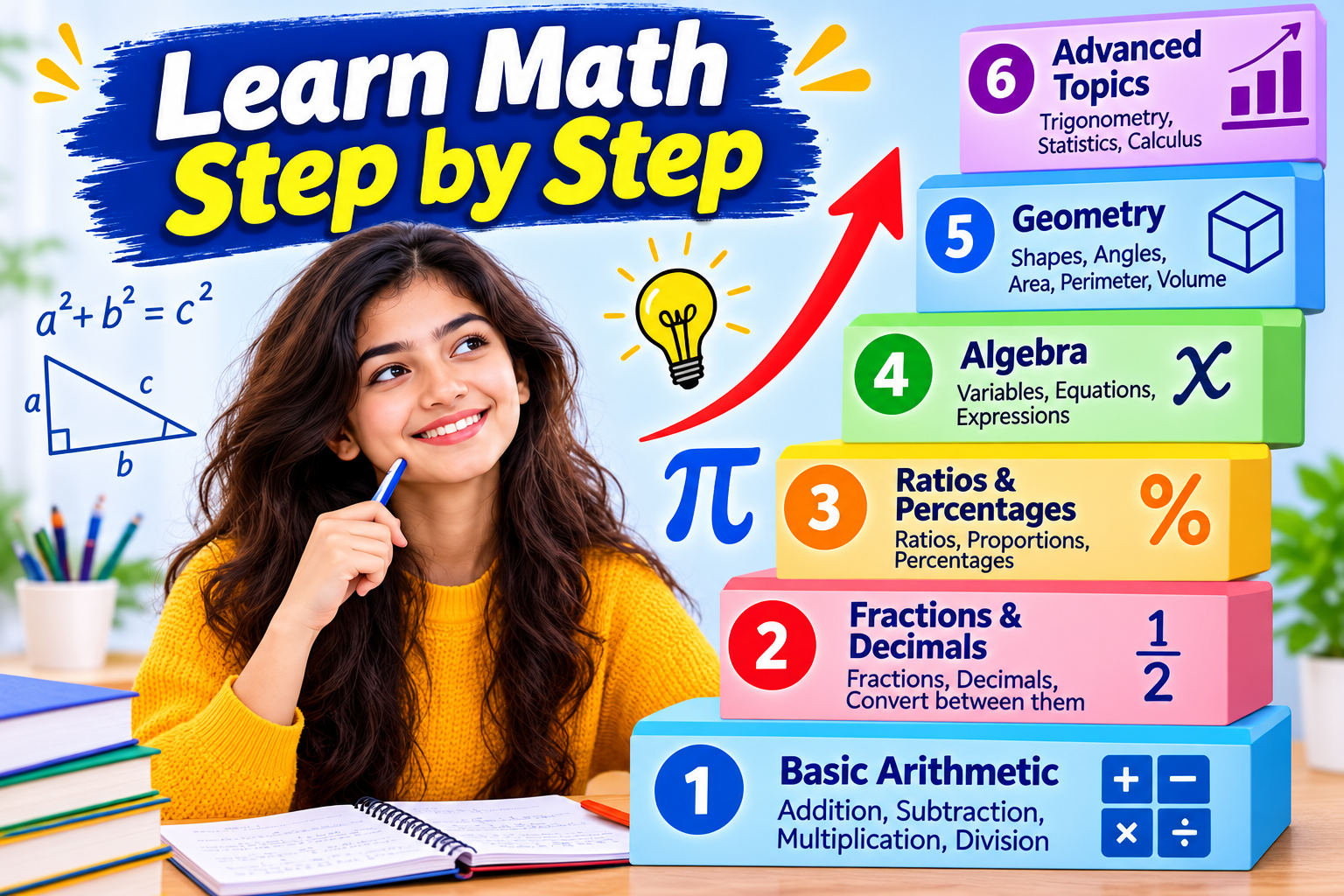
One of the best ways to learn math step by step is to follow a structured learning path. Instead of jumping between unrelated topics, study one concept at a time and build on what you already know.
Here is a simple learning sequence for beginners.
Step 1: Learn basic arithmetic
Start with addition, subtraction, multiplication, and division. Practice simple calculations until you understand how each operation works.
Example:
24 + 16 = 40

45 − 18 = 27

7 × 8 = 56

72 ÷ 9 = 8
Step 2: Understand fractions, decimals, and percentages
Learn how these three forms of numbers are related.
For example:
1/2 = 0.5 = 50%Understanding these relationships makes it easier to solve problems involving money, measurements, and proportions.
Step 3: Learn ratios and proportions
Ratios compare quantities, while proportions show when two ratios are equal.
For example, if two apples cost ₹20, four apples cost ₹40 when the price per apple remains the same.
Step 4: Start learning algebra
Algebra introduces letters and symbols that represent unknown numbers.
For example:
x + 5 = 12

Subtract 5 from both sides:

x = 12 − 5

x = 7
Step 5: Study geometry
Learn about lines, angles, triangles, circles, area, perimeter, and volume. Use drawings to understand how shapes and measurements work.
Step 6: Move to more advanced topics
After building your foundation, explore equations, graphs, exponents, trigonometry, statistics, and other topics relevant to your goals.
This step-by-step approach helps you identify knowledge gaps and makes learning mathematics more manageable.
How to Learn Math Fast and Easy
If you want to improve your math skills quickly, focus on effective learning habits rather than trying to study for long hours without a plan.
The following methods can help you learn more efficiently.
Understand the concept first. Before memorizing a formula, learn what it means and why it works.
Practice every day. Spend 20 to 30 minutes solving problems instead of studying only before exams.
Use worked examples. Study a solved question, understand each step, and then try a similar problem without looking at the solution.
Break difficult topics into smaller parts. Learn one skill at a time rather than trying to understand an entire chapter at once.
Review your mistakes. Identify where you went wrong and solve the question again using the correct method.
Revise regularly. Review formulas and concepts after a day, several days, and a week.
Test yourself. Close your notes and try to recall formulas or solve problems independently.
For example, if you are learning linear equations, begin with simple equations such as x + 3 = 10. After mastering these, move to equations involving multiplication, brackets, and fractions.
This gradual increase in difficulty helps you build confidence while improving your problem-solving ability.
How to Learn Math from the Beginning for Adults
Adults can learn mathematics even if they have not studied it for years. You might want to improve your everyday calculations, prepare for a competitive examination, return to education, or develop skills for your job.
The best approach is to start at your current level rather than assuming you must remember everything from school.
Identify your current math level
Try a few simple questions involving addition, multiplication, fractions, percentages, and basic equations. Notice which topics you can solve comfortably and which ones require revision.
Set a clear learning goal
Your goal might be to manage money more effectively, understand school-level mathematics, prepare for an entrance examination, or learn algebra.
A specific goal helps you decide which topics to prioritize.
Follow a realistic routine
Start with 20 minutes of mathematics practice each day. You can increase the duration when you feel comfortable.
For example, your daily routine could include:
- 5 minutes reviewing an earlier lesson
- 5 minutes learning a new concept
- 10 minutes solving practice questions
Use practical examples
Connect mathematics with everyday activities such as shopping, budgeting, cooking, calculating discounts, and planning travel.
For example, if a product costs ₹800 and has a 10% discount, the discount is ₹80 and the final price is ₹720.
Practical examples make mathematical concepts easier to understand and remember.
Learn without comparing yourself to others
Adults often have different schedules, responsibilities, and learning goals. Focus on your own progress rather than how quickly someone else learns.
You do not need to become an expert overnight. Consistent practice and a willingness to review difficult topics can help you develop stronger mathematical skills over time.
How to Learn Math for Students
Students can improve their mathematics performance by combining classroom learning, regular practice, and effective revision.
Whether you are in primary school, secondary school, or college, it helps to understand each concept before attempting difficult examination questions.
Pay attention to the method
When a teacher explains a problem, focus on why each step is necessary. If you do not understand something, ask questions instead of memorizing the solution.
Complete practice questions
After studying a topic, solve questions from your textbook. Begin with simple examples and gradually move to more challenging exercises.
Maintain a formula notebook
Write down important formulas, definitions, and examples. Organize them by topic so you can find information quickly during revision.
Practice previous-year papers
If you are preparing for an examination, use previous-year question papers and sample papers when available. They help you understand the question format and identify topics that need more practice.
Review mistakes after every test
Do not focus only on your marks. Look at the questions you answered incorrectly and determine whether the problem involved a concept, formula, calculation, or misunderstanding of the question.
Balance speed with accuracy
Solving questions quickly is useful, but correct answers are more important. First learn the correct method, then gradually practice under time limits.
With regular practice, students can improve their confidence, calculation skills, and ability to handle unfamiliar questions.
Understand Math Concepts Instead of Memorizing Everything
Memorizing formulas without understanding them can make mathematics harder. When you understand the meaning behind a formula, it becomes easier to remember and apply it to different problems.
Consider the area of a rectangle.

Area = length × breadth

Suppose a rectangle is 8 cm long and 5 cm wide.

Area = 8 × 5

Area = 40 cm²

Imagine the rectangle divided into small squares. Eight columns and five rows create 40 squares. This visual explanation shows why multiplying the length by the breadth gives the area.
The same principle applies to other mathematical concepts. Use diagrams, examples, and simple explanations to understand why a formula works.
Whenever you learn something new, ask yourself:
- What does this formula represent?
- Why does the method work?
- When should I use it?
- Can I explain it in simple words?
- Can I solve a similar question independently?
Understanding mathematics makes it easier to solve unfamiliar questions instead of depending on memorized examples.
Practice Math Every Day
Regular practice is one of the most effective ways to improve mathematical skills. Reading a chapter or watching a lesson may help you understand a topic, but solving questions yourself develops your ability to apply it.
You can begin with a simple 30-minute routine.
| Time | Activity |
| 5 minutes | Review previously learned concepts |
| 10 minutes | Learn one new concept |
| 10 minutes | Solve practice questions |
| 5 minutes | Check answers and correct mistakes |
Choose a topic for each session. For example, practice fractions on Monday, percentages on Tuesday, and simple algebra on Wednesday.
If you have limited time, even a shorter focused session can be useful. The important thing is to maintain consistency.
As your skills improve, increase the difficulty of your questions. Try to solve problems without checking the answers until you have completed your attempt.
Daily practice helps you recognize patterns, recall methods more easily, and approach difficult questions with greater confidence.
Learn Math Formulas Easily
Mathematical formulas are easier to remember when you understand what they calculate and practice using them.
Instead of memorizing a long list of formulas in one sitting, organize them by topic and learn them through examples.
For example, the perimeter of a rectangle is:
Perimeter = 2 × (length + breadth)

If the length is 8 cm and the breadth is 5 cm:

Perimeter = 2 × (8 + 5)

Perimeter = 2 × 13

Perimeter = 26 cm

The perimeter is the total distance around the rectangle.
Best ways to remember formulas
- Write formulas in a dedicated notebook.
- Understand the meaning of every symbol.
- Solve two or three examples using each formula.
- Test yourself without looking at your notes.
- Use flashcards for important formulas.
- Review difficult formulas at regular intervals.
- Practice mixed questions to learn when each formula applies.
You can also create a formula sheet for topics such as algebra, geometry, trigonometry, and mensuration.
Remember that understanding how a formula works is more valuable than simply memorizing it.
Improve Mental Math and Calculation Speed
Mental math helps you perform simple calculations without writing down every step or relying on a calculator.
Start by learning basic number patterns and shortcuts.
Multiply a number by 5

Multiply the number by 10 and divide the result by 2.

Example:

36 × 5 = 360 ÷ 2 = 180

Find 10% of a number

Divide the number by 10.

Example:

10% of 450 = 450 ÷ 10 = 45

Find 50% of a number

Divide the number by 2.

Example:

50% of 240 = 240 ÷ 2 = 120

Multiply a number by 9

Multiply the number by 10 and subtract the original number.

Example:

32 × 9 = 320 − 32 = 288
Practice a few calculations every day. As you become more comfortable, work on fractions, percentages, multiplication, and other calculations relevant to your studies.
Do not rush to use shortcuts before understanding the basic operations. A good foundation helps you recognize when a shortcut is appropriate.
Use Visual Methods to Understand Math
Visual learning can make abstract mathematical ideas easier to understand.
For example, fractions become clearer when you draw shapes and divide them into equal parts. Geometry becomes more understandable when you draw angles, triangles, and circles.
Try these visual techniques:
- Use number lines to understand negative numbers.
- Draw shapes to learn geometry formulas.
- Use graphs to understand equations and functions.
- Create tables to organize information in word problems.
- Use diagrams to compare fractions and ratios.
- Watch animations that explain difficult concepts.
Interactive graphing tools can also help you see how changing a number affects an equation or graph.
Visual methods are particularly useful for students who find it difficult to understand mathematical symbols through written explanations alone.
Best Sites to Learn Math for Free
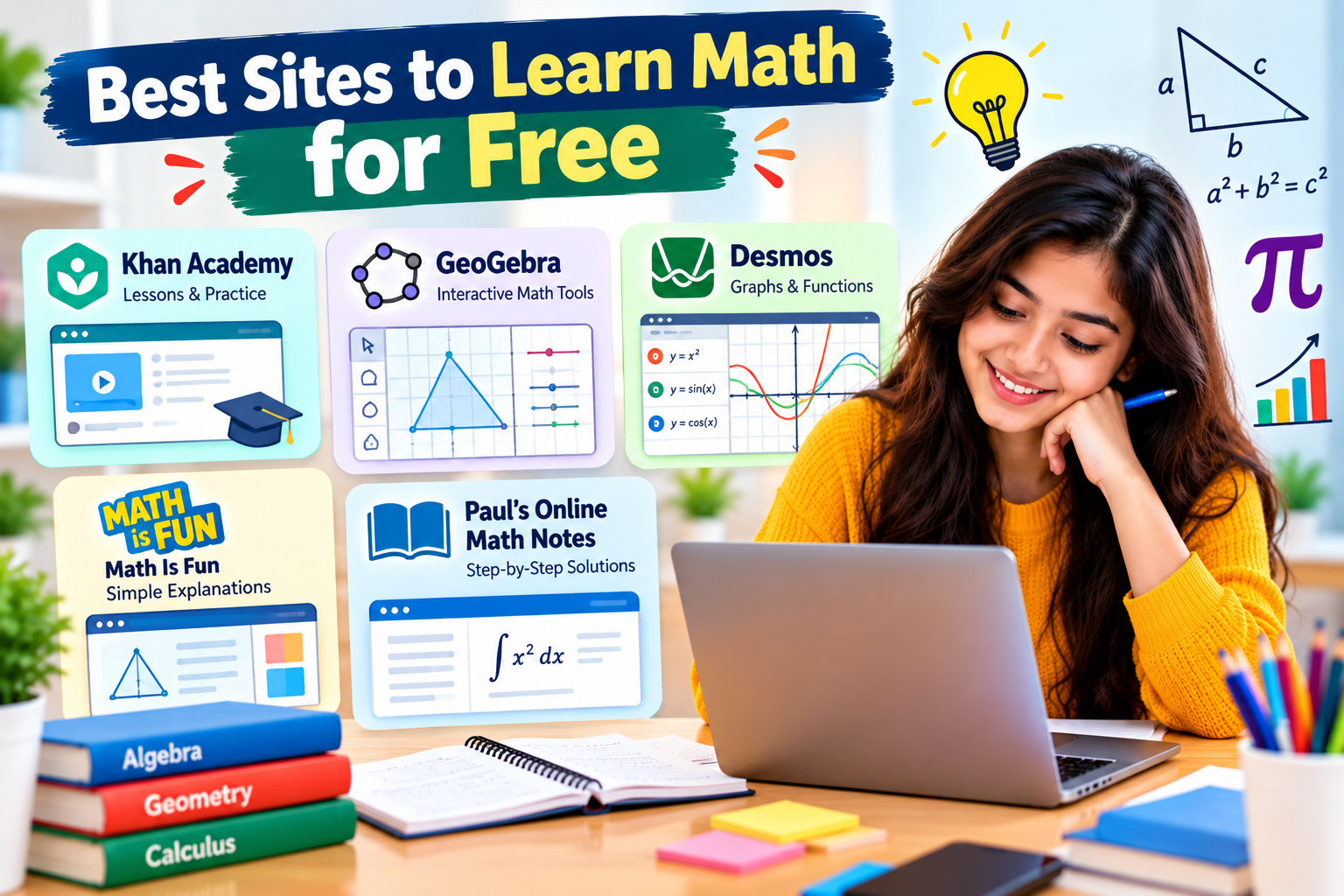
You do not need to pay for a course to begin learning mathematics. Several free educational websites provide lessons, practice exercises, visual explanations, and interactive tools.
Use AI Tools to Learn Math Step by Step
AI math tools can provide explanations, examples, and practice questions based on your learning needs.
For example, you can ask an AI assistant to explain fractions in simple language, solve a linear equation step by step, or create ten practice questions about percentages.
You can also request different explanations if the first one is confusing.
AI tools can be useful when you want to study at your own pace. However, they can sometimes produce incorrect calculations or explanations, so check important answers against reliable learning resources.
Most importantly, try solving each problem yourself before asking for the complete solution. Use AI to understand the method, then practice similar questions without assistance.
Try Free AI Solvers:
Learn How to Solve Math Word Problems
Word problems require you to understand written information and translate it into a mathematical calculation.
The easiest way to approach them is to identify what you know, what you need to find, and which mathematical operation is appropriate.
Consider this example:
A bag costs ₹600 after a discount of ₹100. What was its original price?

Step 1: Identify the information.

Selling price = ₹600

Discount = ₹100

Step 2: Choose the operation.

Original price = Selling price + Discount

Step 3: Calculate the answer.

Original price = ₹600 + ₹100

Answer = ₹700
Follow these steps when solving word problems:
- Read the question carefully.
- Identify the given values.
- Determine what you need to calculate.
- Select the correct formula or operation.
- Write the solution step by step.
- Check whether your answer makes sense.
If you find word problems difficult, start with short questions involving basic arithmetic. Gradually move to more complicated questions involving percentages, ratios, algebra, or geometry.
Learn from Your Math Mistakes
Mistakes are a normal part of learning mathematics. They help you identify which concepts need more attention.
When you answer a question incorrectly, do not simply memorize the correct answer. Find out why your method failed.
Common mistakes include choosing the wrong formula, making calculation errors, forgetting negative signs, skipping steps, and misunderstanding the question.
Keep a notebook of incorrect questions. For each question, record the original problem, the mistake you made, and the correct solution.
Then solve the same question again without looking at the answer.
Review difficult questions after a day or two. If you can solve them correctly on your own, you are improving your understanding.
This technique is particularly helpful for students preparing for school examinations and competitive tests.
Create a Simple Math Study Schedule
A study schedule helps you learn mathematics systematically instead of choosing topics randomly.
You can begin with this weekly plan.
| Day | Topic | Main Goal |
| Monday | Basic arithmetic | Improve calculation skills |
| Tuesday | Fractions and decimals | Understand different number forms |
| Wednesday | Percentages and ratios | Solve practical calculations |
| Thursday | Algebra | Learn expressions and equations |
| Friday | Geometry | Understand shapes, area, and perimeter |
| Saturday | Practice questions | Apply what you have learned |
| Sunday | Revision and testing | Review mistakes and check progress |
Adjust this plan according to your current knowledge. If you are already confident in arithmetic, spend more time on algebra or geometry.
For students preparing for exams, organize the schedule around your syllabus and examination date.
For adults learning mathematics independently, focus on topics that match your practical needs and long-term goals.
A realistic schedule is easier to maintain than a demanding routine that you abandon after a few days.
Use Active Recall and Spaced Revision
Active recall means trying to remember information without looking at your notes. Spaced revision means reviewing a topic several times over a period instead of studying it only once.
Both methods can help you remember mathematical formulas and concepts.
For example, after learning the area of a triangle, close your notebook and recall the formula.
Area of a triangle = ½ × base × heightNext, solve a problem using the formula. Review it again the following day and later in the week.
If you forget the formula, look it up, understand it, and test yourself again.
You can use the same method for algebraic identities, geometry formulas, trigonometric ratios, and other topics.
Instead of repeatedly reading the same page, test what you can remember and identify what needs further practice.
Build Confidence and Overcome Math Anxiety
Some learners become nervous when they see complicated equations or unfamiliar mathematical questions. This anxiety can make it difficult to concentrate and apply what they know.
To build confidence, begin with questions that match your current level. Once you can solve them correctly, gradually increase the difficulty.
Set small goals such as learning one formula, completing five questions, or understanding a concept that previously confused you.
Avoid comparing yourself with other students. Some people learn particular topics quickly, while others need more practice.
If you feel stuck, take a short break and return to the problem with a clear mind. Divide it into smaller steps and focus on one part at a time.
Mathematics is a skill that can improve with practice and feedback. You do not have to understand every topic immediately to become a better learner.
Prepare for Math Exams with a Clear Strategy
If you are learning math to improve your examination results, combine conceptual understanding with regular testing.
Begin by reviewing your syllabus and identifying the topics you find most challenging. Give these topics additional practice time while continuing to revise concepts you already understand.
Useful exam preparation strategies include:
- Practice textbook examples and exercises.
- Revise important formulas regularly.
- Solve previous-year papers when available.
- Take timed practice tests.
- Review incorrect answers carefully.
- Practice writing complete solutions.
- Learn how to manage time during an examination.
Do not focus only on the final answer. Understanding the steps helps you handle questions that use unfamiliar numbers or different wording.
Before an examination, revise key concepts and solve a mixture of easy, medium, and difficult questions.
Common Mistakes to Avoid When Learning Math
Some learning habits can make mathematics more difficult than necessary.
Only watching videos: Tutorials explain concepts, but independent practice is necessary to develop problem-solving skills.
Memorizing without understanding: Learn why formulas work and how to apply them.
Skipping the basics: Review fractions, percentages, arithmetic, and other foundational topics when needed.
Looking at answers too early: Attempt the question independently before checking the solution.
Practicing only easy questions: Start with simple examples, then gradually increase the difficulty.
Ignoring mistakes: Revisit incorrect answers to understand and correct your reasoning.
Studying without a goal: Set a clear objective for every session.
Expecting immediate results: Give yourself time to understand difficult concepts and develop accuracy.
Avoiding these mistakes can help you use your study time more effectively and build a stronger understanding of mathematics.
A 30-Day Plan to Learn Math from the Beginning
If you want to learn mathematics systematically, a 30-day plan can help you organize your practice and build a routine.
This plan is suitable as a starting point for beginners, including adults who want to refresh their basic math skills. Adjust it according to your current level.
Week 1: Build your foundation
Focus on addition, subtraction, multiplication, division, multiplication tables, fractions, and decimals.
Practice simple calculations and identify the areas where you need additional help.
Week 2: Learn percentages, ratios, and practical math
Study percentages, ratios, proportions, averages, and basic word problems.
Apply these concepts to shopping discounts, recipes, travel calculations, and everyday situations.
Week 3: Start algebra and geometry
Learn variables, simple equations, basic geometric shapes, angles, area, and perimeter.
Use worked examples and diagrams to understand the concepts.
Week 4: Practice, revise, and test yourself
Review the topics you studied during the previous weeks. Solve mixed practice questions and revisit your mistakes.
Use free math-learning websites when you need extra explanations or exercises.
At the end of the month, test yourself on the topics you covered. Identify which skills have improved and which topics need more practice.
You may not master every topic in 30 days, and that is completely normal. The goal is to establish a strong foundation and develop a consistent learning habit.
Conclusion
Learning math doesn’t have to be confusing or stressful. Whether you want to learn math fast, study step by step, or start from the beginning as an adult, the right approach can help.
Start with the basics, understand formulas, practice daily, and learn from your mistakes. Use free math-learning websites and real-life examples for extra support.
The best way to learn math is to practice consistently, understand each step, and gradually build your confidence.
Frequently Asked Questions
Can I learn math online for free?
Yes. You can use free online lessons, video tutorials, interactive graphing tools, practice exercises, and educational resources to learn many mathematical topics. You can study at your own pace without paying for a course.
How long does it take to learn math from the beginning?
The time required depends on your starting level, learning goals, practice routine, and the complexity of the topics. You may improve specific skills within a few weeks, while mastering advanced mathematics generally requires much more time.
How can I learn math fast and easy?
Start with basic concepts, study one topic at a time, and practice questions daily. Understand formulas instead of memorizing them blindly, review mistakes, and use worked examples to learn the correct methods.
How can I overcome my fear of math?
Start with manageable problems and celebrate small improvements. Focus on learning rather than comparing yourself with others, and remember that mistakes are part of the learning process.
Can AI help me learn math?
Yes. AI tools can explain concepts, show step-by-step solutions, generate practice questions, and help identify mistakes. Try solving a problem yourself before checking the explanation.