Calculus concepts are essential for understanding how quantities change, how mathematical functions behave, and how small changes combine to produce measurable results. From finding the speed of a moving vehicle to calculating the area under a curve, calculus concepts help students solve mathematical problems that are difficult to approach using algebra alone.
For students learning mathematics, understanding the most important calculus concepts is the first step toward mastering differential calculus, integral calculus, and their real-world applications. These concepts provide the foundation for advanced mathematics, physics, engineering, economics, computer science, and many other fields.
Although calculus may initially seem complicated, its fundamental ideas become easier to understand when studied step by step. Learning limits, continuity, derivatives, differentiation rules, integration, and optimization helps students develop the skills needed to solve more advanced problems.
In this guide, we will explore the top 15 calculus concepts every student should know, with simple explanations, essential formulas, solved examples, and practical applications. Whether you are a beginner, a high school student, or preparing for an examination, these concepts will help you build a stronger mathematical foundation.
What are Calculus Concepts?
Calculus concepts are the fundamental mathematical ideas and techniques used to study change, motion, accumulation, and the behavior of functions. They explain how quantities vary and how many small contributions can be combined to calculate a larger quantity.
For example, algebra can help calculate the distance traveled by a vehicle moving at a constant speed. It can help determine its instantaneous speed when the speed changes continuously over time.
Calculus is generally divided into two main branches: differential calculus and integral calculus.
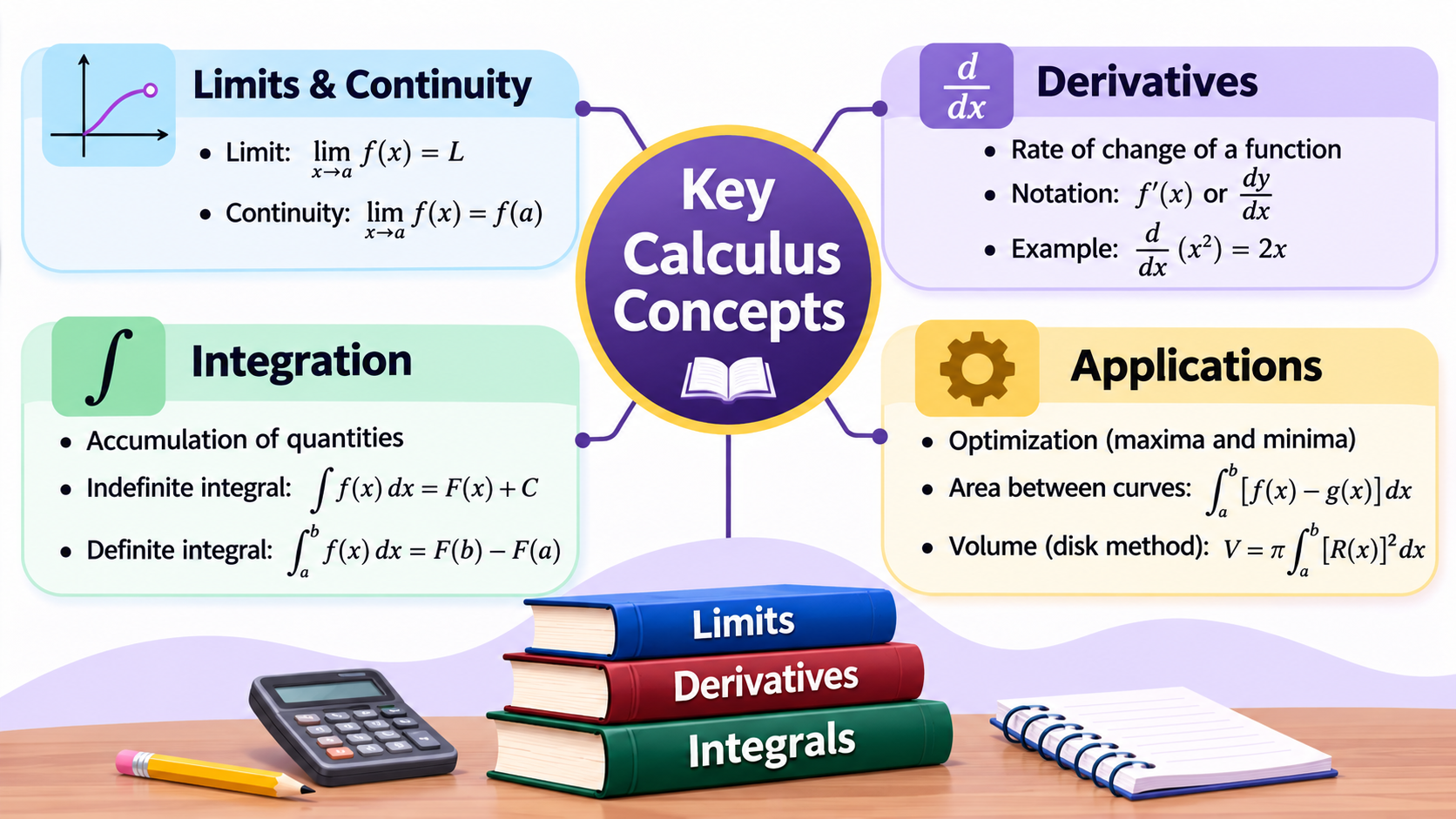
1. Differential Calculus
Differential calculus focuses on rates of change. Its central concept is the derivative, which measures how quickly a function changes at a particular point.
Important differential calculus topics include:
- Limits and continuity
- Derivatives and differentiation rules
- Instantaneous rates of change
- Tangent lines and slopes
- Maximum and minimum values
- Concavity and inflection points
These concepts are useful for analyzing motion, studying changing quantities, and solving optimization problems.
2. Integral Calculus
Integral calculus focuses on accumulation. It helps calculate totals by combining many small contributions and is commonly used to determine areas, volumes, displacement, and accumulated quantities.
Important integral calculus topics include:
- Indefinite integrals
- Definite integrals
- Antiderivatives
- The Fundamental Theorem of Calculus
- Area between curves
- Volumes calculated using integration
Differential calculus and integral calculus are closely related. Understanding their relationship is essential for mastering the subject.
Why are Calculus Concepts Important?
Calculus is useful because many real-world situations involve quantities that change continuously. Instead of relying only on approximate measurements or constant-rate assumptions, calculus allows us to develop more precise mathematical models.
Here are some important reasons to learn calculus:
- Physics: Calculus explains motion, acceleration, forces, energy, and changing physical quantities.
- Engineering: Engineers use calculus to model systems, analyze structures, and optimize designs.
- Economics: Derivatives help analyze marginal cost, marginal revenue, and profit optimization.
- Computer science: Calculus supports machine learning, optimization algorithms, computer graphics, and scientific computing.
- Biology: Mathematical models use calculus to describe population changes and biological processes.
- Geometry: Integration helps determine areas, volumes, and other measurements involving curved shapes.
For students, understanding these concepts also creates a strong foundation for advanced mathematics, university courses, and competitive examinations.
Top 15 Calculus Concepts Every Student Should Know
The following sections explain 15 important calculus concepts, beginning with the foundations and progressing toward more advanced applications.
1. Limits: The Foundation of Calculus
Limits describe how a function behaves as its input approaches a particular value. The function does not necessarily need to equal the approaching value at the point itself.
A limit represents the value that a function approaches when its input gets closer and closer to a specified number. The function does not necessarily need to equal that value at the point itself.
Limit Formula
The standard notation for a limit is:

lim (x → a) f(x) = L

This means that f(x) approaches L as x approaches a.
Example of a Limit
Find:

lim (x → 2) (x² + 3)

Solution:

Substitute x = 2 into the expression:

= 2² + 3

= 4 + 3

= 7

Therefore:

lim (x → 2) (x² + 3) = 7

This example demonstrates a basic limit that can be evaluated through direct substitution.
A Limit That Requires Simplification
Consider:

lim (x → 3) (x² − 9)/(x − 3)

Direct substitution produces 0/0, which is an indeterminate form.

Factor the numerator:

x² − 9 = (x − 3)(x + 3)

For x ≠ 3, simplify the expression:

(x² − 9)/(x − 3) = x + 3

Now evaluate the limit:

lim (x → 3) (x + 3) = 6

Therefore:

lim (x → 3) (x² − 9)/(x − 3) = 6

Although the original expression is undefined at x = 3, its limit exists and equals 6.
Why Are Limits Important?
Limits provide the mathematical foundation for several other calculus concepts, including derivatives, continuity, and definite integrals. They help students analyze functions near points where direct substitution may not work.
Understanding limits is one of the first steps toward learning calculus successfully.
2. Continuity of Functions
Continuity is another important concept in calculus. Continuity describes whether a function behaves without a break at a particular point. Informally, a continuous graph can be drawn through the point without lifting your pencil, although this visual description is not a complete mathematical definition.
A function f(x) is continuous at x = a when three conditions are satisfied:

f(a) is defined.

lim (x → a) f(x) exists.

lim (x → a) f(x) = f(a).

If any condition fails, the function is not continuous at that point.

Example of Continuity

Consider:

f(x) = x² + 1

Determine whether the function is continuous at x = 2.

First, calculate the function value:

f(2) = 2² + 1 = 5

Next, calculate the limit:

lim (x → 2) (x² + 1) = 5

Since the limit exists and equals the function value, the function is continuous at x = 2.
Types of Discontinuity
Students studying calculus should understand three common types of discontinuity:
- Removable discontinuity: A missing point or hole in the graph.
- Jump discontinuity: The left-hand and right-hand limits have different finite values.
- Infinite discontinuity: The function grows without bound near a point, as can happen near a vertical asymptote.
Why Is Continuity Important?
Continuity helps determine whether certain mathematical theorems can be applied to a function. Many important results involving limits, derivatives, and integration require continuity on a specified interval.
Remember that a function can be continuous at a point without being differentiable there.
3. Derivatives: Measuring Instantaneous Change
Derivatives are among the most widely used calculus concepts. A derivative measures the instantaneous rate of change of a function with respect to its input.
Geometrically, the derivative represents the slope of the tangent line to a function’s graph at a point when the derivative exists.
For example, if a function describes the position of a moving vehicle over time, its derivative describes the vehicle’s instantaneous velocity.
Definition of a Derivative
The derivative of f(x) is defined as:

f'(x) = lim (h → 0) [f(x + h) − f(x)]/h
This formula starts with the average rate of change over a small interval and examines what happens as the interval approaches zero.
This formula starts with the average rate of change over a small interval and examines what happens as the interval approaches zero.
Example of a Derivative
Find the derivative of:

f(x) = x²

Using the definition:

f'(x) = lim (h → 0) [(x + h)² − x²]/h

Expand the square:

= lim (h → 0) [x² + 2xh + h² − x²]/h

Simplify:

= lim (h → 0) (2xh + h²)/h

Cancel h:

= lim (h → 0) (2x + h)

As h approaches zero:

f'(x) = 2x

Therefore, the derivative of x² is 2x.

At x = 3:

f'(3) = 2 × 3 = 6

The slope of the curve y = x² at x = 3 is 6.
Common Derivative Notations
Several notations represent derivatives:
f'(x)
y'
dy/dx
d/dx [f(x)]1

Each notation represents differentiation with respect to the specified variable.
Applications of Derivatives
Derivatives help answer practical questions, such as:
- How fast is an object moving at a particular moment?
- How quickly is a population growing?
- Where does a function reach a maximum or minimum?
- How does production cost change as output increases?
- What is the slope of a curve at a particular point?
Understanding derivatives is essential for mastering differential calculus and its applications.
4. Basic Rules of Differentiation
Differentiation is the process of finding a derivative. Although derivatives can be defined using limits, differentiation rules make calculations faster and easier.
These rules are among the most useful calculus formulas students should learn.
Important Differentiation Formulas
| Function | Derivative |
| f(x) = c | f'(x) = 0 |
| f(x) = x | f'(x) = 1 |
| f(x) = xⁿ | f'(x) = nxⁿ⁻¹ |
| f(x) = sin x | f'(x) = cos x |
| f(x) = cos x | f'(x) = −sin x |
| f(x) = eˣ | f'(x) = eˣ |
| f(x) = ln x | f'(x) = 1/x, for x > 0 |
Here, c and n are constants, and the formulas apply wherever the corresponding functions are differentiable.
The Power Rule
The power rule is one of the easiest differentiation rules to learn.
Formula:

d/dx (xⁿ) = nxⁿ⁻¹

To apply this rule, multiply the function by its exponent and reduce the exponent by one.

Example

Differentiate:

f(x) = 5x³ + 4x² − 7x + 9

Differentiate each term separately:

Derivative of 5x³ = 15x².

Derivative of 4x² = 8x.

Derivative of −7x = −7.

Derivative of 9 = 0.

Therefore:

f'(x) = 15x² + 8x − 7

The constant term disappears because a constant function does not change as x changes.
Why Are Differentiation Rules Important?
Differentiation rules allow students to calculate derivatives without repeatedly using the limit definition. They also provide the foundation for more advanced topics, including optimization, related rates, and curve analysis.
5. The Chain Rule: Differentiating Composite Functions
The chain rule is used when one function is contained inside another function. These expressions are known as composite functions.
For example:

y = (3x + 2)⁴

The expression 3x + 2 is inside the fourth power, so differentiating the expression requires the chain rule.

Chain Rule Formula

If:

y = f(g(x))

then:

dy/dx = f'(g(x)) × g'(x)

In simple terms, differentiate the outer function while keeping the inner expression unchanged, then multiply by the derivative of the inner expression.

Example of the Chain Rule

Differentiate:

y = (3x + 2)⁴

Step 1: Differentiate the outer power.

4(3x + 2)³

Step 2: Differentiate the inner expression.

d/dx (3x + 2) = 3

Step 3: Multiply both results.

dy/dx = 4(3x + 2)³ × 3

Therefore:

dy/dx = 12(3x + 2)³

Another Example

Find the derivative of:

y = sin(x²)

The derivative of sin(u) is cos(u) multiplied by du/dx, where u = x².

Therefore:

dy/dx = 2x cos(x²)
Applications of the Chain Rule
The chain rule is useful for differentiating powers of algebraic expressions, trigonometric functions with variable expressions, exponential functions, and logarithmic functions.
It is particularly important when working with complex functions that contain multiple layers of mathematical operations.
6. Product Rule and Quotient Rule
The product rule and quotient rule are differentiation techniques used when functions are multiplied or divided.
Students should understand these rules because many expressions cannot be differentiated correctly by applying the power rule alone.
Product Rule Formula

If:

y = u × v

then:

dy/dx = u(dv/dx) + v(du/dx)

Multiply the first function by the derivative of the second, then add the second function multiplied by the derivative of the first.

Product Rule Example

Differentiate:

y = x² sin x

Let:

u = x² and v = sin x

Their derivatives are:

du/dx = 2x

dv/dx = cos x

Apply the product rule:

dy/dx = x² cos x + sin x × 2x

Therefore:

dy/dx = x² cos x + 2x sin x

Quotient Rule Formula

If:

y = u/v

then, where v ≠ 0:

dy/dx = [v(du/dx) − u(dv/dx)]/v²

The order of subtraction matters. The formula uses the denominator multiplied by the derivative of the numerator, minus the numerator multiplied by the derivative of the denominator.

Quotient Rule Example

Differentiate:

y = x/(x + 1)

Let:

u = x and v = x + 1

Then:

du/dx = 1

dv/dx = 1

Apply the quotient rule:

dy/dx = [(x + 1)(1) − x(1)]/(x + 1)²

Simplify:

= (x + 1 − x)/(x + 1)²

Therefore:

dy/dx = 1/(x + 1)², for x ≠ −1.
When Should You Use These Rules?
- Use the product rule when two variable functions are multiplied.
- Use the quotient rule when one variable function is divided by another.
- Use the chain rule when a function is nested inside another function.
Simplifying an expression before differentiation can sometimes make the solution shorter and easier to understand.
7. Higher-Order Derivatives
Higher-order derivatives are obtained by differentiating a function more than once. They are important because they explain how the rate of change of a function changes.
The first derivative measures the rate of change of a function. The second derivative measures how that rate changes. Further differentiation produces third, fourth, and higher-order derivatives.
Example of Higher-Order Derivatives
Consider:

f(x) = x³

First derivative:

f'(x) = 3x²

Second derivative:

f''(x) = 6x

Third derivative:

f'''(x) = 6

Therefore, the first three derivatives are:

First derivative: 3x².

Second derivative: 6x.

Third derivative: 6.
Applications of Higher-Order Derivatives
In physics, if s(t) represents position, then s'(t) represents velocity and s”(t) represents acceleration.
In graph analysis, the second derivative helps determine whether a graph is concave upward or downward.
In optimization, the second derivative can help classify stationary points as local maxima or minima.
Higher-order derivatives also appear in mathematical models involving vibrations, waves, motion, and physical systems.
8. Applications of Derivatives: Maximum and Minimum Values
Optimization is one of the most useful applications of calculus concepts. It involves finding the largest or smallest possible value of a quantity under specified conditions.
Examples include maximizing profit, minimizing production costs, finding the shortest distance, and determining the dimensions of a shape with the greatest area.
Critical Points
For a differentiable function, a critical point occurs where the derivative equals zero or where the derivative does not exist, provided the function itself is defined at that point.
A point where f'(x) = 0 is called a stationary point.

Critical points are important candidates for local maxima and minima, but not every critical point represents an extreme value.

Example: Finding a Minimum

Consider:

f(x) = x² − 6x + 10

Step 1: Differentiate.

f'(x) = 2x − 6

Step 2: Set the derivative equal to zero.

2x − 6 = 0

2x = 6

x = 3

Step 3: Calculate the second derivative.

f''(x) = 2

Since f''(3) = 2, which is positive, the function has a local minimum at x = 3. Because this is an upward-opening quadratic, it is also the global minimum.

Step 4: Calculate the minimum value.

f(3) = 3² − 6(3) + 10

= 9 − 18 + 10

= 1

Therefore, the minimum value is 1 at x = 3.
First and Second Derivative Tests
The first derivative test examines how the sign of f'(x) changes around a critical point.
- Positive to negative: local maximum.
- Negative to positive: local minimum.
- No sign change: neither a local maximum nor a local minimum at that point.
The second derivative test examines f”(x) at a stationary point.
- If f”(x) > 0, the point is a local minimum.
- If f”(x) < 0, the point is a local maximum.
- If f”(x) = 0, the test is inconclusive.
For a function defined on a closed interval, check the endpoints as well as the interior critical points when finding absolute maximum and minimum values.
9. Increasing and Decreasing Functions
Increasing and decreasing functions are important calculus concepts used to describe how a function behaves as its input changes.
A function is increasing on an interval when larger input values produce larger function values. It is decreasing when larger input values produce smaller function values.
For a differentiable function, the sign of the first derivative provides a useful test.
- If f'(x) > 0 throughout an interval, f is increasing there.
- If f'(x) < 0 throughout an interval, f is decreasing there.
Example

Consider:

f(x) = x²

Differentiate:

f'(x) = 2x

When x < 0, the derivative is negative. Therefore, the function decreases as x approaches zero from the left.

When x > 0, the derivative is positive. Therefore, the function increases to the right of zero.

The function reaches its minimum value at x = 0.
This example shows how derivatives can explain the behavior and shape of a graph without calculating numerous individual points.
10. Concavity and Inflection Points
Concavity describes the way a graph bends. The second derivative is commonly used to study this behavior.
These mathematical techniques help students understand changes in the shape of a graph and identify possible inflection points.
Concavity of a Function
For a twice-differentiable function:
- If f”(x) > 0 on an interval, the graph is concave upward.
- If f”(x) < 0 on an interval, the graph is concave downward.
A graph that is concave upward bends like a cup, while a graph that is concave downward bends like an upside-down cup.
Inflection Points
An inflection point is a point where the graph changes concavity.
A common method for finding possible inflection points is to solve:
f''(x) = 0However, this only identifies candidates. You must verify that the concavity actually changes across the point. Inflection points may also occur where the second derivative is undefined.
Example of an Inflection Point

Consider:

f(x) = x³

First derivative:

f'(x) = 3x²

Second derivative:

f''(x) = 6x

Set the second derivative equal to zero:

6x = 0

x = 0

When x < 0, f''(x) is negative. When x > 0, f''(x) is positive.

Therefore, the graph changes from concave downward to concave upward at x = 0.

Since f(0) = 0, the inflection point is:

(0, 0)

Concavity analysis is useful when sketching graphs and studying how the rate of change of a function behaves.
11. Integration: The Process of Accumulation
Integration is one of the central calculus concepts used to calculate accumulated quantities. It can be understood as the reverse process of differentiation when finding an antiderivative.
Integration also provides a way to calculate areas and other totals by adding many small contributions.
There are two major types of integrals: indefinite integrals and definite integrals.
An indefinite integral represents a family of antiderivatives.
It is written as:
∫ f(x) dx = F(x) + CHere:
- f(x) is the function being integrated.
- F(x) is an antiderivative of f(x).
- C is the constant of integration.
The constant is necessary because the derivative of any constant is zero.
Basic Integration Formula
The power rule for integration is:
∫ xⁿ dx = xⁿ⁺¹/(n + 1) + C, for n ≠ −1.This rule increases the exponent by one and divides by the new exponent.
Example of Indefinite Integration
Find:
∫ x² dx

Increase the power by one:

x²⁺¹ = x³

Divide by the new power:

∫ x² dx = x³/3 + C

To verify the answer, differentiate x³/3 + C:

d/dx (x³/3 + C) = x²

The original function is recovered, confirming the result.
Definite Integrals
A definite integral calculates the net accumulation of a function over a specified interval.
It is written as:
∫ₐᵇ f(x) dxHere, a is the lower limit and b is the upper limit.
When f(x) is nonnegative throughout the interval, the definite integral represents the area between the graph and the x-axis. When the function takes negative values, those portions contribute negatively to the integral.
Example of a Definite Integral
Evaluate:
∫₀² x dx

An antiderivative of x is x²/2.

Therefore:

∫₀² x dx = [x²/2]₀²

Substitute the upper and lower limits:

= 2²/2 − 0²/2

= 4/2 − 0

= 2

The definite integral equals 2.
Applications of Integration
Integration is used to calculate:
- Areas under curves.
- Displacement from velocity.
- Total distance when speed is nonnegative.
- Volumes of solids.
- Accumulated costs and revenue.
- Work done by a variable force.
Understanding integration helps students connect mathematical expressions with measurable quantities.
12. The Fundamental Theorem of Calculus
The Fundamental Theorem of Calculus establishes a relationship between differentiation and integration. It explains why these two major mathematical processes are closely connected.
The theorem is commonly presented in two parts.
Part One: Differentiating an Accumulation Function
Suppose f is continuous and define:

F(x) = ∫ₐˣ f(t) dt

Then:

F'(x) = f(x)

This means that differentiating the accumulated integral returns the original function.

The variable t is a dummy variable inside the integral, while x represents the variable upper limit.
Part Two: Evaluating a Definite Integral
If F is an antiderivative of f, then:

∫ₐᵇ f(x) dx = F(b) − F(a)

This formula allows us to evaluate a definite integral by finding an antiderivative and calculating the difference between its values at the upper and lower limits.

Example

Evaluate:

∫₁³ 2x dx

First, find the antiderivative:

F(x) = x²

Apply the theorem:

∫₁³ 2x dx = F(3) − F(1)

= 3² − 1²

= 9 − 1

= 8
The Fundamental Theorem of Calculus makes many integration problems easier to solve without evaluating a limit of sums from scratch.
Why Is This Theorem Important?
The theorem connects two major branches of calculus:
- Differentiation measures instantaneous change.
- Integration calculates accumulated quantities.
It allows students to move between these processes and solve a wide range of mathematical problems efficiently.
13. Area Between Curves
Integration can calculate the area enclosed by two curves. This is an important application of calculus concepts in geometry, engineering, economics, and other fields.
When one curve lies above another over an interval, the area between them is calculated by integrating their vertical difference.
Formula for Area Between Curves
If f(x) is the upper curve and g(x) is the lower curve from x = a to x = b, then:

Area = ∫ₐᵇ [f(x) − g(x)] dx

The upper function must be subtracted from the lower function in the correct order: upper minus lower.
Example of Area Between Curves
Find the area between:

y = 2x and y = x²

over the interval from x = 0 to x = 2.

On this interval, 2x lies above x².

Therefore:

Area = ∫₀² (2x − x²) dx

Integrate each term:

= [x² − x³/3]₀²

Substitute the limits:

= (2² − 2³/3) − 0

= 4 − 8/3

= 12/3 − 8/3

Area = 4/3 square units

This method works because integration adds the small vertical differences between the two curves across the interval.
Important Point
If the curves cross within the interval, you may need to split the integral at their intersection points so that the upper function is correctly identified in each section.
14. Volumes Using Integration
Integration can calculate the volume of three-dimensional objects, particularly solids whose cross-sectional areas change along an axis.
Instead of treating a solid as one indivisible object, calculus divides it conceptually into thin slices. Integration combines the small contributions to calculate the total volume.
Disk Method Formula
When a region is revolved around an axis and produces circular cross-sections with radius R(x), the disk method gives:

V = π ∫ₐᵇ [R(x)]² dx

This formula applies when the solid can be described using disks perpendicular to the axis of integration.
Example: Volume of a Cone
A right circular cone has height h and base radius r.

Consider a cone formed by revolving a straight line around the x-axis, with x running from 0 at the tip to h at the base.

The radius of a cross-section at position x is:

R(x) = rx/h

Using the disk method:

V = π ∫₀ʰ (rx/h)² dx

Take the constants outside the integral:

V = πr²/h² ∫₀ʰ x² dx

Integrate:

V = πr²/h² [x³/3]₀ʰ

Substitute the limits:

V = πr²/h² × h³/3

Therefore:

V = (1/3)πr²h

This is the familiar formula for the volume of a cone, derived using integration.
Other Methods for Finding Volume
Depending on the shape, students may also encounter:
- The washer method, which uses cross-sections with a hole.
- The cylindrical shell method, which uses thin cylindrical layers.
- Cross-sectional integration, which adds areas of slices perpendicular to an axis.
15. Differential Equations
Differential equations contain an unknown function and one or more of its derivatives. They are useful when a problem describes how a quantity changes rather than directly specifying its value.
For example, population growth may depend on the current population. The cooling of an object may depend on the difference between its temperature and the surrounding temperature.
A Simple Differential Equation
Consider:

dy/dx = 2x

This equation tells us that the derivative of y with respect to x equals 2x.

Integrate both sides:

∫ dy = ∫ 2x dx

Therefore:

y = x² + C

The constant C appears because many functions have the same derivative.
Using an Initial Condition
Suppose y = 1 when x = 0.

Substitute these values:

1 = 0² + C

Therefore:

C = 1

The particular solution is:

y = x² + 1

The initial condition identifies one specific function from the family of possible solutions.
Applications of Differential Equations
Differential equations are used in:
- Population growth and decay
- Motion and acceleration
- Radioactive decay
- Heat transfer and cooling
- Electrical circuits
- Fluid flow
- Mathematical models of biological systems
Students usually begin with simple first-order differential equations before progressing to more advanced mathematical models.
Important Calculus Formulas to Remember
The following table summarizes essential calculus concepts and formulas for quick revision.
| Calculus concept | Important formula |
| Power rule for differentiation | d/dx (xⁿ) = nxⁿ⁻¹ |
| Constant rule | d/dx (c) = 0 |
| Product rule | (uv)’ = u’v + uv’ |
| Quotient rule | (u/v)’ = (u’v − uv’)/v² |
| Chain rule | d/dx [f(g(x))] = f'(g(x))g'(x) |
| Power rule for integration | ∫xⁿ dx = xⁿ⁺¹/(n + 1) + C, n ≠ −1 |
| Definite integral | ∫ₐᵇ f(x) dx = F(b) − F(a) |
| Area between curves | ∫ₐᵇ [f(x) − g(x)] dx |
| Disk method | V = π∫ₐᵇ [R(x)]² dx |
These formulas are useful for revision, but students should also understand the meaning of each formula and the conditions under which it applies.
Real-Life Applications of Calculus Concepts
Calculus concepts are not limited to textbook exercises. They are widely used to model, predict, and optimize real-world systems.
1. Physics and Motion
If s(t) represents an object’s position over time, differentiation gives its velocity:
v(t) = ds/dtDifferentiating velocity gives acceleration:
a(t) = dv/dtIntegration can work in the opposite direction. Integrating velocity over a time interval gives displacement.
2. Engineering and Design
Engineers use calculus to analyze how structures and mechanical systems respond to changing conditions. Integration helps calculate volumes, work, and other accumulated quantities.
3. Economics and Business
Businesses use derivatives to study marginal cost, marginal revenue, and changes in profit.
Optimization techniques can help identify production levels that maximize profit or minimize cost, provided the mathematical model and its assumptions are appropriate.
4. Computer Science and Artificial Intelligence
Calculus plays an important role in optimization methods used to train many machine-learning models. Derivatives help determine how changes in model parameters affect an error or loss function.
Calculus also supports computer graphics, simulation, and numerical methods.
5. Biology and Environmental Science
Differential equations can model population changes, the spread of certain diseases, and interactions between species. Integration can calculate accumulated quantities, such as total growth over a period.
6. Geometry and Architecture
Integration can calculate the areas of curved regions, volumes of complex solids, and lengths of certain curves. These applications connect calculus with geometric measurement and design.
Try Free AI Solvers:
How to Learn Calculus Concepts Effectively
Learning calculus requires more than memorizing formulas. A good study strategy combines conceptual understanding, algebraic skills, worked examples, and regular practice.
1. Strengthen Your Algebra Skills
Make sure you are comfortable with factorization, equations, exponents, fractions, and simplifying expressions. Many calculus mistakes are actually algebra mistakes.
2. Learn Limits Before Derivatives
Limits explain the mathematical foundation of derivatives and definite integrals. Spend time understanding what a function approaches and how one-sided limits behave.
3. Understand the Meaning of Each Formula
For example, the derivative of a position function represents velocity. Understanding this interpretation makes the formula more meaningful and helps you recognize when to apply it.
4. Practice One Differentiation Rule at a Time
Begin with the power rule, then practice the product, quotient, and chain rules. Once you understand each rule individually, combine them in more complex problems.
5. Use Graphs to Visualize Calculus Concepts
Graphs help you understand limits, continuity, tangent lines, maxima, minima, and concavity. Visualizing a function can reveal why a mathematical result makes sense.
6. Connect Differentiation With Integration
Remember that derivatives and integrals are closely related. Differentiation studies instantaneous rates of change, while integration studies accumulation. The Fundamental Theorem of Calculus connects the two.
7. Review Your Mistakes
When an answer is incorrect, identify the source of the error. Check whether you chose the wrong rule, made an algebraic mistake, omitted a constant, or applied a theorem without satisfying its conditions.
8. Solve Different Types of Problems
Practice direct calculations, graph-based questions, word problems, and real-world applications. Different question types help develop a deeper understanding of the same underlying calculus concepts.
9. Create a Calculus Formula Sheet
Keep a concise list of important formulas with a short explanation and one example for each. Review it regularly while continuing to solve problems independently.
10. Progress From Basic to Advanced Topics
Build your understanding in a logical sequence: functions, limits, continuity, derivatives, applications of derivatives, integration, and then more advanced applications.
Following this sequence helps you develop a strong foundation before moving on to challenging topics.
Common Mistakes Students Make When Learning Calculus Topics
Avoiding common mistakes can improve both understanding and accuracy.
Confusing a function value with a limit: A function may be undefined at a point even though its limit exists there.
Forgetting the constant of integration: An indefinite integral generally requires + C because differentiation removes constant terms.
Applying the chain rule incorrectly: When differentiating a composite function, remember to multiply by the derivative of the inner function.
Reversing the quotient rule: The numerator is the denominator multiplied by the derivative of the numerator, minus the numerator multiplied by the derivative of the denominator.
Assuming every stationary point is a maximum or minimum: A zero derivative does not guarantee an extreme value. Check how the function behaves around the point.
Ignoring integration limits: In a definite integral, the upper and lower limits determine the interval over which accumulation is calculated.
Forgetting the domain: Expressions involving division, logarithms, or square roots may have restrictions that affect where a function or derivative is defined.
Memorizing without understanding: Calculus formulas are easier to apply correctly when you understand what they represent and why they work.
Conclusion: Master the Most Important Calculus Concepts
Calculus concepts provide a systematic way to understand change, motion, and accumulation. The most important foundations include limits, continuity, derivatives, and integrals, while techniques such as the chain rule, optimization, concavity analysis, and differential equations extend these ideas to more complicated problems.
The best way to master calculus is to focus on meaning as well as formulas. Understand what a derivative represents, why limits matter, how integrals measure accumulation, and how the Fundamental Theorem of Calculus connects differentiation with integration.
With a strong foundation and consistent practice, students can approach mathematical problems with greater confidence and apply their knowledge to physics, engineering, economics, computer science, geometry, and many other subjects.
Frequently Asked Questions
Is calculus difficult for beginners?
Calculus can be challenging at first because it combines algebra, functions, limits, and new mathematical notation. However, learning each concept step by step and practicing regularly can make the subject much more manageable.
How many calculus concepts should a student learn first?
Students should begin with the main foundational concepts, including functions, limits, continuity, derivatives, and integration. The 15 important calculus concepts covered in this guide provide a useful starting point for learning the subject systematically.
What is the easiest way to learn calculus concepts?
Start with functions, limits, and continuity. Next, learn derivatives and differentiation rules, followed by optimization and integration. Practice with simple examples before moving to more advanced problems.
Can calculus concepts be used in everyday life?
Yes. Calculus is used in motion analysis, engineering, economic modeling, machine learning, population studies, and geometric measurement. Its applications are especially important when quantities change continuously or when a total must be calculated from varying values.